
08.08.2026
iGaming Software: White Label vs Turnkey vs Custom Build
Read article

There is one good reason to accept TRON payments: that is where your customers' money already is. USDT on TRON is the everyday settlement currency across the CIS, Southeast Asia and Latin America, and a share of those buyers cannot pay by card at all. If that is your audience, the question is closed — add it. If your customers hold their USDT on Ethereum or on an exchange in another network, TRON gives them nothing extra, and chasing it is work for no revenue.
Now the number to unlearn. "TRON fees are a fraction of a cent" is a 2021 figure. Today a USDT TRC-20 transfer burns about 6.5 TRX, which is roughly two dollars. To an address that holds no USDT yet it burns about 13 TRX — roughly four dollars. Transfers get cheap only for a sender who has energy, the TRON resource that pays for token transfers, and energy comes from staking TRX or from renting it. At checkout, that bill goes to your customer, not to you. So the real price of TRON for your business is the payments that never complete.
They get used interchangeably, and that is where the confusion at checkout starts.
So "USDT TRC-20" means the Tether dollar, issued on TRON, following that standard. Same dollar as USDT on Ethereum, different rails — and the rails do not connect. Wallets and exchanges usually label the network selector "TRC-20" rather than "TRON", which is why the two names feel like synonyms.
One thing to teach your support team is address formats. A TRON address starts with a capital T and uses the Base58Check format; Ethereum, BNB Chain and Polygon addresses start with 0x. Those formats carry a checksum, so a 0x address pasted into a TRON withdrawal is rejected outright — that mistake stops at the input field. The mistake that actually loses money is the one no interface can catch: the same 0x address exists on every Ethereum-compatible chain, so a withdrawal sent on the wrong one of those lands at your address on a chain nobody is watching. If your customer holds TRON funds in a wallet of their own, TronLink is the one they most likely have.
TRON does not charge gas the way Ethereum does. It charges two separate resources. Bandwidth pays for the size of a transaction in bytes; every account gets 600 units of it free per day. Energy pays for running smart-contract code — and USDT is a smart contract, so every USDT transfer needs energy. Energy is never free: you get it by staking TRX, by having it delegated to you, or by burning TRX on the spot.
The burn price is fixed by the network at 100 sun per unit of energy, which is 0.0001 TRX, and 1,000 sun per byte of bandwidth — both published in TRON's documentation on paying for resources. The rest is arithmetic:
Two dollars is the ceiling, not a starting point. TRON's dynamic energy model multiplies a busy contract's energy cost by a factor capped at 3.4×, and the USDT contract already sits at that cap — so the 65,000 and 130,000 figures are what a transfer costs after the multiplier, and they do not climb higher at peak hours. Sending plain TRX rather than a token is a different and much cheaper matter. A standard TRX transfer is 270 bytes, so it fits inside the 600 free bandwidth units every account gets each day — for most customers it costs nothing at all, and only 0.27 TRX once that daily quota is spent. If you sell to people who hold TRX, accepting the coin itself is the cheapest thing you can offer them.
What the price actually depends on is which of three states your sender is in.
Cheap TRON transfers are a property of the sender, then, not of the network. Your first-time customer is almost always in state one or two.
Your customer does. When someone sends USDT to a payment address on your site, their wallet spends their energy or burns their TRX. You receive the full invoice amount.
That sounds like good news, and mostly it is — but it relocates the problem instead of removing it. The customer with $200 of USDT and zero TRX in their wallet is not a rare case; it is the standard state of anyone who just withdrew stablecoin from an exchange. Their wallet refuses to send, they do not know why, and they leave. That abandoned checkout is what TRON costs you.
Your own network costs begin later, on the way out: when a processor sweeps the per-order deposit addresses into one balance, and when you withdraw. Those transfers are token transfers too, with the same energy bill. So put one question to every provider you shortlist, in these words: who handles energy on withdrawals, and is it priced into your rate or billed on top? How the different layers of fee stack up is broken out in the guide to how crypto payment fees work.
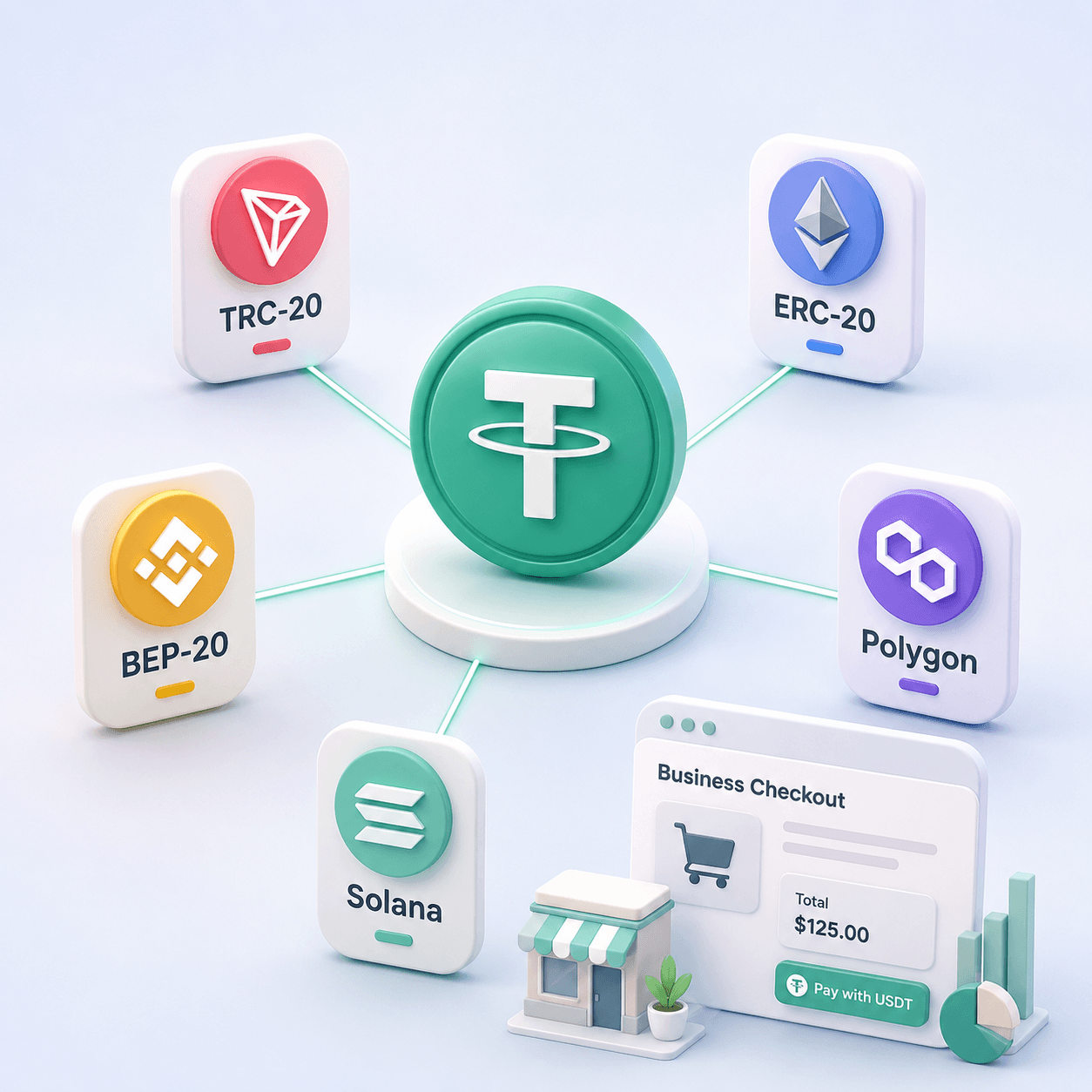
To accept TRC-20 on your online store without touching a node, you buy the plumbing. A TRC-20 payment gateway issues a fresh address for each order, watches the network for the payment, fires a webhook to your backend, locks the exchange rate, and deals with sweeping and withdrawals. That is the whole job, and it is why almost every business should buy it rather than build it.
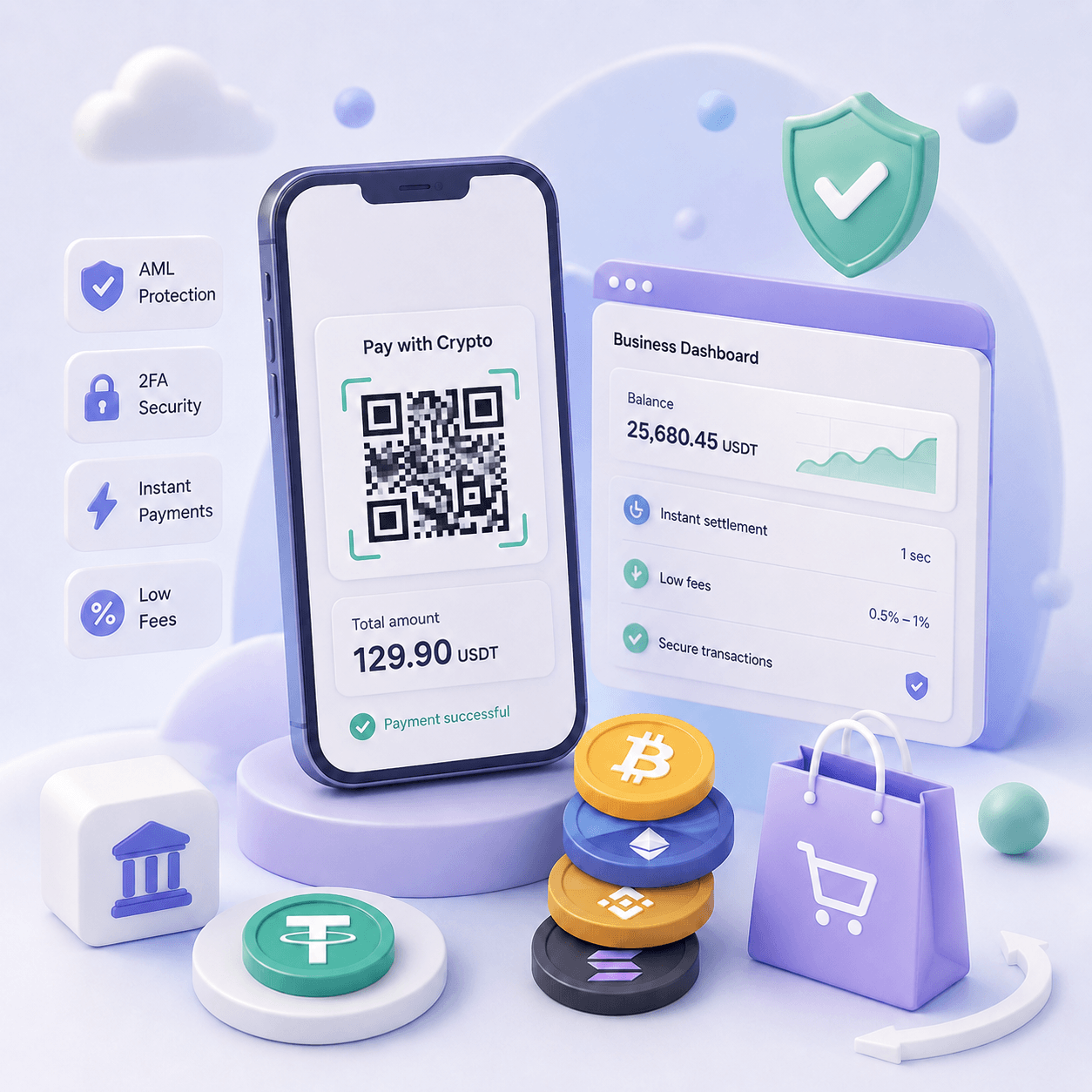
The headline percentage is the number that tells you least. Before you integrate, get three answers in writing: the rate for your actual scenario — multi-currency acceptance and passing the fee to the customer are often priced separately, — who pays for energy on sweeps and withdrawals, and whether there is a withdrawal minimum. A provider that publishes only its acceptance rate has not told you what happens on the way out; treat that as the answer and ask before you sign anything.
For example, the CryptumPay gateway charges 1% per successful payment, from 0.5% once volume justifies it, and the fee can be passed on to your customer instead of coming out of your margin. Incoming funds are converted to USDT as soon as they arrive, so the balance never sits in a volatile coin, and withdrawals to your own wallet are open at any time with no minimum.
You can publish one TRON address and reconcile manually. It costs nothing and works while the volume is tiny. Past about ten payments a month it turns into a reconciliation job: who paid, for which order, why the amount is short by $3, and whether the customer who emailed at 2 a.m. is one of the three unmatched transfers. If you want the low-effort version done properly, payment links and QR invoices give each customer a unique amount and address without an integration.
Build your own only if both of these are true.
Miss either one and you are paying salary to rebuild a solved problem.
What decides between these three routes is volume and your refund policy — not what you sell. An online store, a SaaS subscription, an iGaming platform, a freelance marketplace and a mobile app with in-app purchases all land on the same three options; the store with a handful of orders a month belongs on a payment link, and the platform taking deposits around the clock belongs on an API, whatever the industry label. Fast deposit cycles do have their own operational shape, covered in how crypto payments work for casinos and betting platforms.
The technical part runs from a few hours on a hosted widget to a few days for a full API integration; what usually takes longer is the provider's business verification, and only they can tell you how long theirs runs. The wider setup of accepting crypto — refunds, accounting, rate handling — is in the guide to crypto acquiring for business.
The customer has USDT but no TRX. One of the most common failures, and the one that quietly eats conversion: the wallet will not sign the transfer without energy or TRX to burn. A warning at checkout is only half a fix — it turns a confused customer into an informed one who still cannot pay. The other half is telling them what to do about it, in one line next to the address: buy a few dollars of TRX on the exchange they withdrew the USDT from and send it to the same wallet. On your side, offer a second network at checkout so the customer with no TRX has somewhere to go instead of away. The mechanics, including the gasless approaches that try to remove this step entirely, are unpacked in why a USDT payment fails without gas.
Wrong network. Not the cross-format kind — a 0x address pasted into a TRON withdrawal is rejected by the interface before anything is signed. The real case is same format, wrong chain: the customer withdraws USDT to your 0x address but picks BNB Chain instead of Ethereum. The funds exist, at your address, on a chain your provider is not watching. From a self-custody wallet you can reach them by importing the key; from a custodial deposit address it is a support ticket with a fee and no guarantee, as Binance's own note on incorrect deposits spells out. Put the network name next to the address in words, not only in a dropdown.
The amount does not match. Exchange withdrawal fees come out of the amount the customer typed, so invoices arrive a dollar or two short as a matter of routine. Two decisions close this. Pick a provider that settles underpayment and overpayment automatically rather than by email. And set your own tolerance in absolute terms — a dollar or two on a typical invoice — because the gap is the sending exchange's own withdrawal fee, a flat amount it sets and revises on its own schedule; chasing anything smaller costs more in support time than the shortfall.
"I paid and you did not credit it." Every TRON transaction is public. Ask for the transaction hash and check it yourself on TronScan — the walkthrough on checking a transaction in a block explorer shows what confirmed, pending and failed look like. Most of these tickets end with the customer having sent from an exchange that had not yet released the withdrawal.
Screen incoming funds before you credit them, and never let your whole working balance sit on one address. Those two habits are the entire answer to this section, and here is why they are needed.
USDT is not cash. Tether can freeze the balance on any address, and it does so regularly: by BlockSec's count of frozen USDT across Ethereum and TRON, the larger share by far sits on TRON. A freeze does not take money from you — it takes your ability to move it, which for an operating business is the same thing. Screening at the door means tainted funds get stopped before they touch a balance you depend on; CryptumPay's AML filter, for instance, holds suspicious funds before they reach the merchant's balance rather than clawing them back afterwards. Ask any provider you shortlist how they handle it, and what happens to a payment their filter stops.
Legally: accepting cryptocurrency for goods and services is regulated country by country, and the rules differ sharply. Russian residents are barred by law from accepting digital currency as payment for goods, work or services (Federal Law 259-FZ of 31 July 2020, art. 14(5)) — this article addresses internationally operating businesses. That is the position as of 6 August 2026, and it is not legal advice; check your own jurisdiction with your lawyer before you switch anything on.
Accept USDT TRC-20 if your buyers are in the regions where it is already the working money, or if they are asking for it by name. The network fee is not on your books, so the thing to design around is the customer who holds USDT and no TRX. Skip TRX itself as a payment currency unless you sell to a TRON-native audience; a stablecoin removes the gap between the price you quoted and the amount you receive. And when you compare providers, put your attention on the exit — withdrawal terms and who pays for energy — because that is the part of the bill that is genuinely yours.
No — and you will not manage to. TRON addresses start with a capital T, Ethereum-compatible ones with 0x, and the checksum built into each format means the other one fails validation before the transfer is ever signed. The expensive mistake is a different one: sending on the wrong Ethereum-compatible network to an address that looks perfectly correct, because a 0x address exists on all of them.
Not to receive them — incoming transfers are paid for by the sender. You need TRX or energy when funds move out: sweeping deposit addresses and paying withdrawals are token transfers with the same energy cost. A processor normally handles this for you; ask whether it is inside the rate or billed separately.
TRON produces a block every three seconds, so a transfer appears on-chain almost immediately. The network treats it as irreversible once 19 of TRON's 27 block-producing nodes, its super representatives, have built on that block, which the TRON glossary puts at roughly a minute behind the head of the chain. After that it is not the network you are waiting for: your provider sets its own confirmation threshold, and the slowest part is usually the withdrawal queue at the exchange your customer is sending from.
Only if you sell something to a TRON-native audience that would genuinely rather pay in the coin. For everyone else USDT TRC-20 is enough: a stablecoin means the amount you invoiced and the amount you can spend are the same number.
Some providers allow it, so the percentage lands on the buyer instead of your margin — check the setting before you sign up, because not every gateway offers it. The network fee is already on the customer's side by design, so what you are deciding here is only the processing percentage.
Create an account and connect the checkout yourself, or talk to sales and we will plan the integration with you.