

03.06.2026
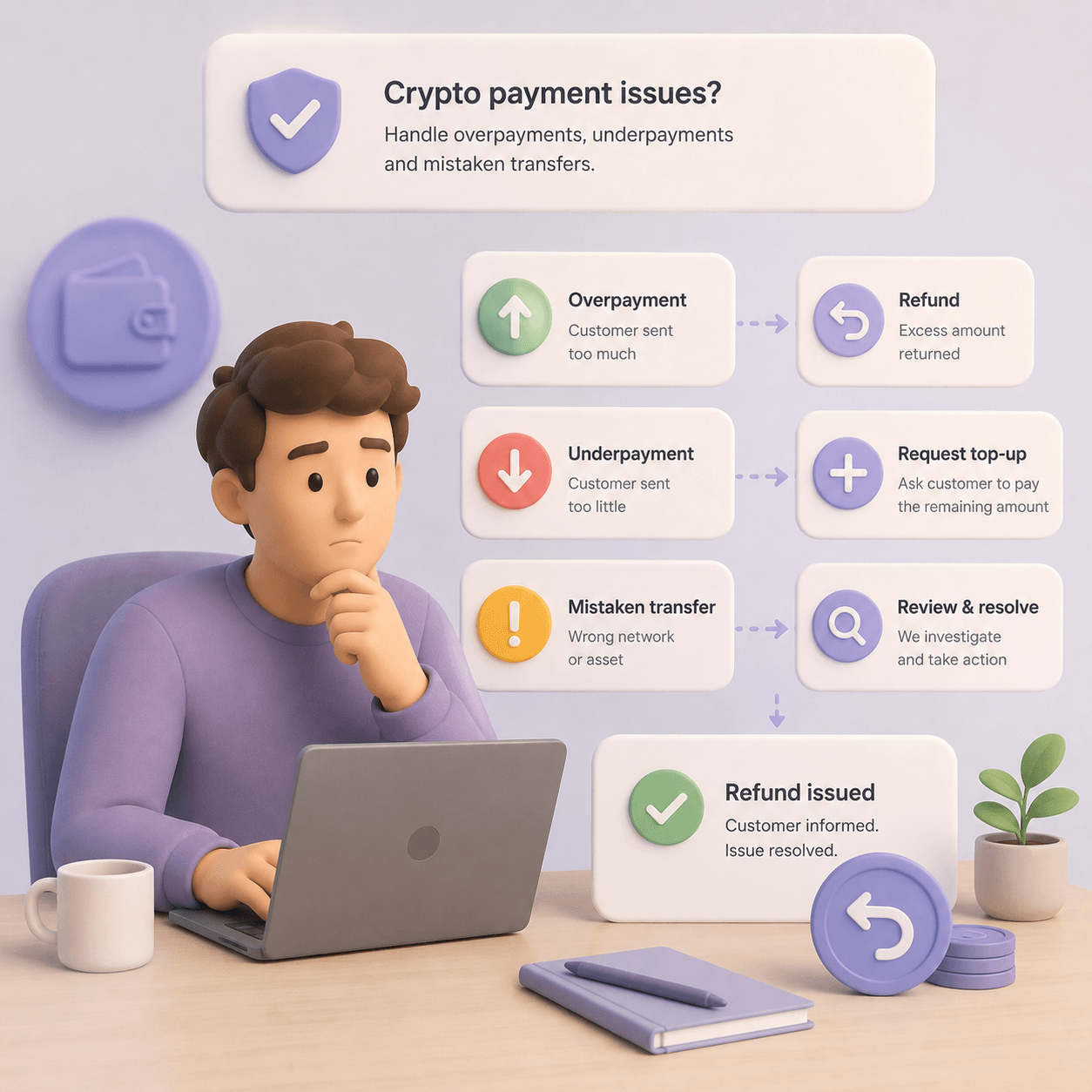
Crypto Payment Refunds: How Businesses Should Handle Errors
Read article
AI and API products are starting to expose a weakness in traditional billing: many digital services are no longer consumed only by humans clicking through a checkout page.
An AI agent may need to buy access to a data endpoint for one task. A developer tool may want to charge per API call instead of forcing a subscription. A model workflow may need to pay for search, storage, inference, identity checks, or third-party tools while it is running. In those cases, the old pattern — create an account, add a card, choose a plan, wait for billing — can be too slow and too manual.
That is the problem x402 payments are trying to solve.
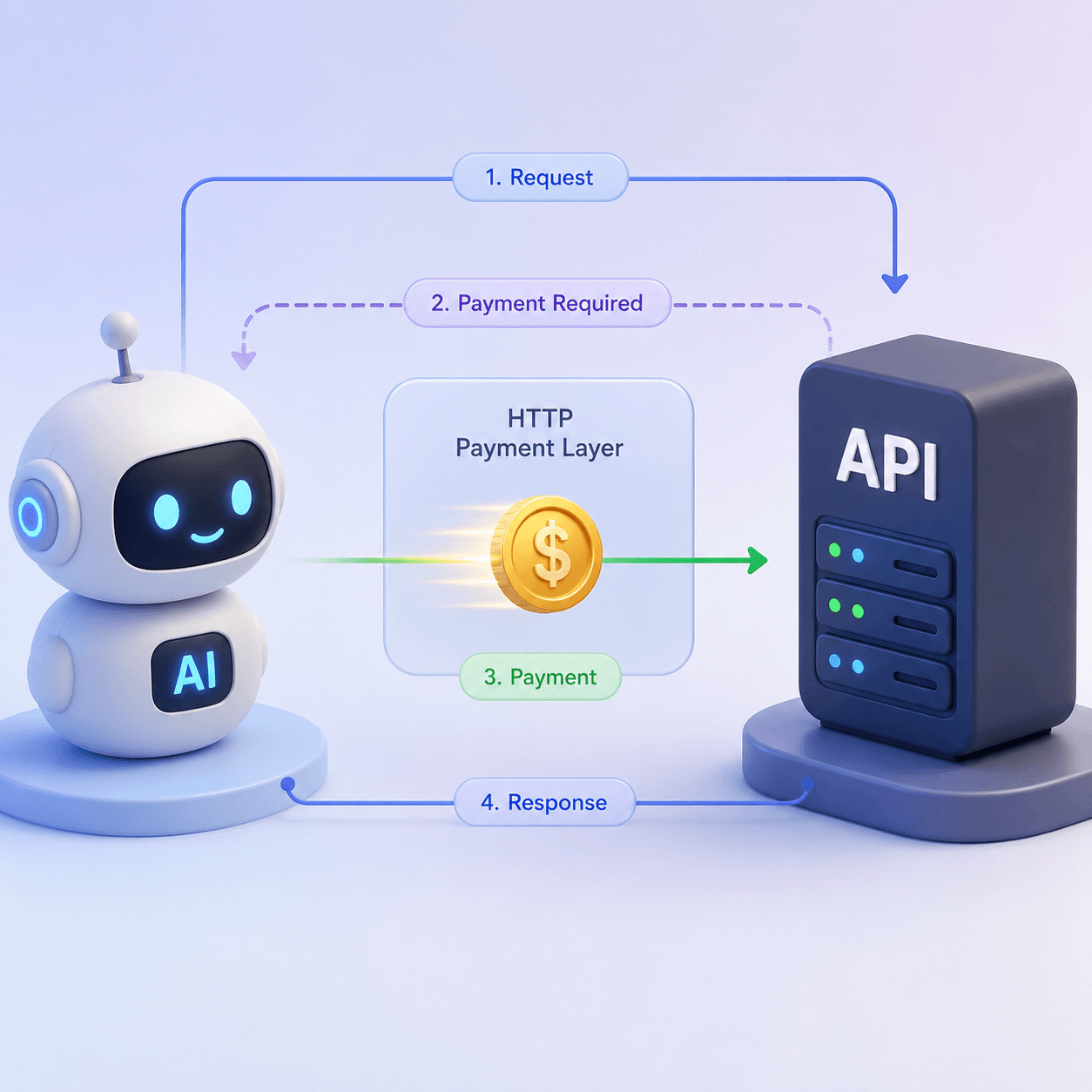
x402 is an open payment protocol that uses the HTTP 402 “Payment Required” status to let APIs, apps, and AI agents request and complete payment as part of a normal web interaction. In practice, it means a server can say: “This resource costs this amount; pay here; then retry the request with proof of payment.”
For developers, the idea is simple: payment becomes closer to an API primitive. For businesses, the real question is more practical: when does this model help, what should you charge for, and what controls need to exist before autonomous software starts moving money?
x402 is a protocol for internet-native payments. It revives the long-reserved HTTP 402 Payment Required status code and turns it into a working payment flow for digital resources.
Instead of sending a user to a separate checkout page, a paid API endpoint can respond with payment requirements. The client — a human-facing app, script, service, or AI agent — can then authorize payment, send proof, and receive the requested resource.
A simplified x402 flow looks like this:
The payment itself is often discussed in the context of stablecoins such as USDC, because stablecoins are programmable, available on blockchain networks, and better suited to small machine-driven payments than volatile crypto assets. But the broader point is not only “pay with crypto.” It is “make payment negotiable and verifiable inside the same internet workflow that requests the resource.”
Traditional online payments assume a human is present.
A person can read a pricing page, create an account, enter a card, accept terms, receive an email, and manage a subscription. That works for many SaaS products. It works less well when the buyer is software.
AI agents and automated workflows create different requirements:
This is why x402 is especially relevant for API products, developer tools, AI infrastructure, data providers, search APIs, paywalled content, model-context services, and micro-SaaS tools.
The same logic is already visible in recurring crypto payments for SaaS. When usage is continuous, top-ups and usage-based billing can be more natural than one large upfront payment. x402 pushes that idea further: each request can carry its own payment context.
Micropayments have been discussed for decades, but most payment systems were not built for very small, high-frequency transactions.
A card payment for $0.01 is usually not practical. Bank transfers are too slow and expensive for per-request billing. Subscriptions solve the payment problem by bundling usage into a larger plan, but they create other problems: unused credits, plan limits, refunds, trial abuse, and friction for occasional users.
Stablecoin micropayments change the design space because they can support programmable, always-on, cross-border settlement. For AI and API products, this opens several pricing models:
This does not mean every API should abandon subscriptions. Many products still need monthly plans, enterprise contracts, invoicing, and minimum commitments. But x402 gives teams another option when the customer does not want a full account relationship or when the buyer is an automated system.
For businesses accepting stablecoins, the finance layer still matters. Revenue needs to be matched to usage, fees need to be visible, balances need to be controlled, and settlement needs to be reconciled. That is why teams experimenting with x402 should also think about stablecoin payment operations for CFOs, not only developer integration.
x402 is not a universal replacement for checkout. It is strongest where the product is already digital, instantly deliverable, and easy to price in small units.
A data provider can expose a paid endpoint without forcing every buyer to create an account or commit to a plan. This is useful for niche datasets, enrichment APIs, price feeds, search endpoints, geolocation, risk scoring, translation, scraping, and analytics.
The value is not only lower friction. It also changes distribution. If AI agents can discover and pay for an endpoint programmatically, the API becomes a product that software can buy directly.
Agents need tools: search, browsing, storage, verification, computation, payments, identity, messaging, and domain-specific APIs. If each tool requires manual onboarding, the agent workflow breaks.
With x402-style payments, a tool can expose a price and access rule directly. The agent can decide whether the cost is within budget, pay, and continue.
Many SaaS products already have usage-based elements: credits, top-ups, API calls, seats, overages, storage, compute minutes, or export limits. x402 can support a more granular version of this model for developer-facing products.
It is especially relevant for low-touch SaaS where a user or agent may only need a small task completed. A full subscription can be too much friction for that kind of demand.
x402 can also apply to reports, files, media, paywalled articles, templates, research snippets, premium prompts, and other digital resources. The key requirement is that access can be granted immediately after payment verification.
Some future use cases will not involve a human buyer at all. One service may pay another service for a task. An agent may buy data from another agent. A workflow may pay for compute, then pay for validation, then pay for delivery.
This is still early, but it is the direction behind machine-to-machine payments: software systems need a payment rail that is as programmable as the APIs they use.
x402 can help with payment negotiation and settlement, but it does not automatically solve the whole payment operating model.
A production-grade payment system still needs decisions around risk, compliance, refunds, customer support, reporting, and product access. These issues do not disappear because the payment is embedded in HTTP.
The biggest risk in agent payments is not whether an agent can pay. It is whether it should.
Every agentic payment setup needs clear boundaries:
For human users, payment intent is often expressed by clicking a button. For agents, intent needs to be represented through policy, signatures, mandates, budgets, and audit logs.
Many x402 use cases are designed to work without traditional accounts, but businesses still need to know enough to manage risk. Some endpoints can be fully open and low-risk. Others may require identity, reputation, API-level access rules, fraud screening, or merchant approval.
This is especially important when the service is regulated, high-value, sensitive, or vulnerable to abuse.
Stablecoin payments can be difficult or impossible to reverse at the network level. That may reduce some chargeback exposure, but it also means the product must define its own refund and dispute process.
For example:
A good x402 implementation should have idempotency, receipts, request IDs, payment IDs, and clear refund logic.
Developers should not treat x402 payments as invisible plumbing. Payment flows need observability.
At minimum, teams should track:
This is closely connected to how to reduce failed crypto payments. In ordinary crypto checkout, users fail because of wrong networks, missing gas, amount errors, expired invoices, or unclear statuses. In x402, the user may be software, but the need for clear payment states becomes even more important.
Traditional API monetization usually relies on API keys, dashboards, prepaid credits, invoices, or subscriptions. That model is familiar and works well for many businesses.
x402 changes the trade-off.
With a subscription, the business gets predictable revenue and a customer relationship. With x402, the business can sell access with less onboarding friction and more granular pricing.
A practical way to think about it:
For many API companies, the likely outcome is not “x402 replaces SaaS billing.” It is “x402 becomes an additional rail for specific use cases.”
A developer API might keep enterprise contracts, keep free tiers, keep monthly plans, and add x402 for occasional usage, agent access, partner tools, or premium endpoints.
Before implementing x402 payments, define the product and operational rules. The protocol is only one part of the system.
Do not start with “we want x402.” Start with the billable unit.
Possible units include:
The unit should be understandable, measurable, and connected to real value.
Machine buyers can compare prices quickly. That makes pricing clarity important.
Define:
If prices change per request, the payment instructions must be clear enough for the client or agent to decide whether to proceed.
Payment systems need protection against duplicate requests. AI agents and automated clients may retry aggressively after timeouts. Without idempotency, the same task can be charged twice.
Use request IDs, payment IDs, and deterministic retry handling. If a client retries after payment, the system should recognize the previous payment and return the resource when appropriate.
Each payment should have a clear lifecycle.
For example:
Do not make developers, finance, or support infer state from raw blockchain data.
Stablecoin payments can happen across different networks, and each network has different costs, confirmation patterns, liquidity, wallet support, and user expectations.
For AI/API micropayments, the best network is not simply the one with the most brand recognition. It is the one that fits your transaction size, expected frequency, latency tolerance, and operational model.
This is why teams should understand crypto network fees before building pricing around small payment amounts. A micropayment model fails if the payment cost is larger than the resource being sold.
Not every API needs the same level of screening. A public weather endpoint and a high-risk financial service are not equal. Still, teams should not add compliance thinking after launch.
Consider:
Requirements depend on jurisdiction, product category, transaction size, custody model, and the role of each provider. This article is not legal advice, but the practical point is simple: payment automation increases the need for clear controls.
For broader payment-risk thinking, see secure crypto payments, AML and KYC.
x402 makes the request-and-payment layer more programmable, but businesses still need infrastructure around it.
That infrastructure includes:
A raw wallet address is rarely enough for a business that needs to operate payments at scale. This is where a crypto payment gateway can be useful: it helps bridge product checkout, blockchain transactions, merchant reporting, and operational controls.
CryptumPay, for example, is built for businesses that need to accept crypto payments on a website, app, Telegram bot, or digital platform. Its current product logic is focused on merchant crypto payments rather than x402 as a protocol, but the underlying business needs are similar: clear payment status, stablecoin settlement, fee handling, AML checks, API integration, and a payment flow that reduces manual wallet errors.
For AI and API products, those operational details become even more important because machine payments can happen faster than a human support team can react.
Many teams should not rush into x402 production immediately. The ecosystem is still developing, and implementation choices may change. But AI/API companies can prepare now by improving the payment architecture around usage-based billing.
Start with these steps:
This work is useful even without x402. It improves SaaS top-ups, crypto checkout, API billing, support workflows, and future agent-payment experiments.
If your product already accepts stablecoins or is considering it, compare the asset side first. The guide to USDT and other stablecoins is a good starting point for understanding why stablecoins are usually more practical than volatile crypto for product pricing and business reporting.
x402 payments make the most sense when all of these conditions are true:
Good-fit examples include developer APIs, AI tools, data feeds, search APIs, inference services, MCP tools, premium content endpoints, SaaS top-ups, verification APIs, and agent-to-agent services.
Weak-fit examples include high-value enterprise contracts, products that require complex procurement, services with heavy manual onboarding, regulated products without a clear compliance model, and consumer products where cards or local payment methods already work well.
No. AI agents are one of the strongest use cases, but x402 can also be used by applications, scripts, developer tools, and human-facing services that want to monetize APIs or digital resources through HTTP-native payments.
Not necessarily. x402 is better understood as an additional payment rail. Subscriptions still work well for predictable access, enterprise contracts, support, and customer relationships. x402 is more interesting for pay-per-use access, agent payments, and small digital transactions.
Stablecoins are useful because they are programmable, available on blockchain networks, and easier to price in than volatile crypto assets. For API and AI products, a stable unit of account is usually more practical than charging in BTC or ETH.
The main risk is uncontrolled automation. If an AI agent can spend money, the system needs limits, authorization, receipts, audit logs, error handling, and refund rules. A payment flow that works technically can still fail operationally if those controls are missing.
No. Teams should first identify a real use case: paid endpoints, agent access, per-request billing, or low-friction API monetization. If your product still depends on enterprise contracts, manual onboarding, or complex compliance review, x402 may be better treated as an experiment for a limited endpoint.
x402 matters because it points to a different shape of internet payments. Instead of forcing every digital transaction through a human checkout, it lets APIs, agents, and web services negotiate payment inside the request itself.
That does not make payments effortless. It moves the hard work into product architecture: pricing, authorization, limits, settlement, retries, reconciliation, risk controls, and support visibility.
For AI and API products, the best approach is pragmatic. Use x402 where per-request stablecoin payments create a better product experience. Keep subscriptions, invoices, and traditional payment methods where they still fit. Build your payment system so it can support both human buyers and software buyers.
The companies that benefit most will not be the ones that add the newest protocol first. They will be the ones that make machine payments observable, controlled, and commercially useful.
Create an account and connect the checkout yourself, or talk to sales and we will plan the integration with you.

