


14.11.2024
SaaS International Payments Guide: Cards, Bank Transfers, MoR and Stablecoins
Read article
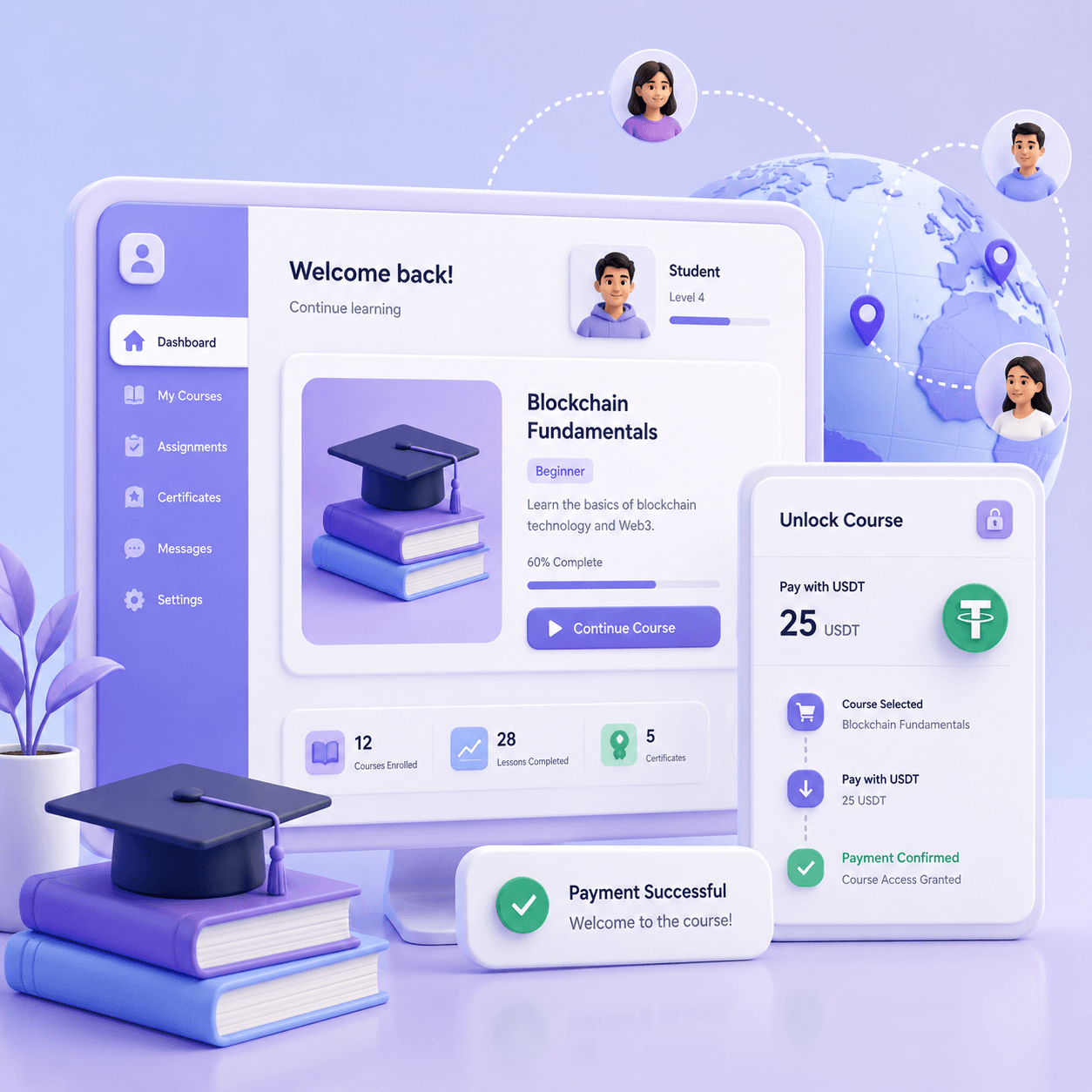
Online education sells a digital product, but many platforms still lose students at a very physical point in the journey: payment.
A student wants to buy a course, join a cohort, renew a membership, or pay for tutoring credits. The card fails. The bank blocks the transaction. A cross-border transfer is slow or expensive. A local payment method is unavailable. The student messages support: “I want to pay, but I can’t.”
Crypto payments for online education can solve part of this problem. Not as a replacement for cards, bank transfers, wallets, or local payment methods, but as an additional payment rail for students who already use crypto or stablecoins.
For an online school, LMS platform, bootcamp, course marketplace, or EdTech subscription, the real question is not “Can we accept crypto?” The question is: can we accept crypto in a way that automatically matches the payment to the student, opens the right course access, reduces manual checks, and gives finance a clean record of what happened?
That is where crypto payments become an education operations topic, not just a checkout feature.
Crypto payments are most useful when an education business has international demand, digital delivery, and a clear access event after payment.
Good-fit scenarios include:
The strongest fit is usually where the student already holds crypto or stablecoins, or where traditional payment methods create friction. This can happen with international students, crypto-native audiences, Web3 education products, developer bootcamps, trading academies, global creator communities, and platforms selling to markets where card acceptance is inconsistent.
Crypto is not a universal fix. If almost all students pay successfully by local cards, there is no international audience, and nobody asks for crypto, the impact may be limited. But if payment failures, cross-border fees, bank restrictions, slow transfers, or support-heavy manual payments are already visible, crypto payments can become a useful additional route.
If your team is still evaluating the basics, start with the broader guide to what a crypto payment gateway is and how it works. For education platforms, the gateway is only one part of the system. The larger design question is how payment status connects to course access, student records, subscription state, and finance operations.
Online education does not have one payment model. A $49 mini-course, a $3,000 cohort, a monthly membership, and a prepaid tutoring balance all need different logic.
Before choosing coins, networks, or a provider, separate the payment scenarios your platform actually needs.
This is the simplest crypto payment model. A student chooses a course, pays a fixed amount, and gets access after the transaction is confirmed.
The risk is manual matching. If the platform simply shows one wallet address and asks students to send USDT, the support team has to match every payment manually: amount, network, wallet, transaction hash, time, email address, and course name.
That may work for the first few sales. It does not work well when volume grows.
A better flow looks like this:
This model fits self-paced courses, recorded workshops, certification modules, downloadable materials, and paid knowledge products.
Cohorts are more sensitive than self-paced courses because payment affects a real schedule. A student may need access before a start date, a group assignment, a live session, or a mentor introduction.
If a bootcamp has multiple tiers, the payment must also carry context: basic access, mentor support, certificate track, team plan, or premium package.
For crypto payments, cohort-based education needs clear rules:
The payment system should not only confirm that money arrived. It should help the product and operations teams decide what happens next.
Subscriptions are more complex. Card subscriptions usually rely on automatic recurring charges. Crypto payments often require the user to confirm a new transaction, unless the product uses a specific balance, authorization, or saved payment flow.
For online education, this means a membership model should be designed carefully. Good options include:
This fits learning communities, language platforms, creator academies, paid newsletters, private Discord/Telegram groups, and subscription-based course libraries.
The logic is similar to SaaS renewals, but the business event is different. In SaaS, payment controls product access. In education, payment may control lessons, homework, certificates, live calls, community access, or mentor time. The article on recurring crypto payments for SaaS is a useful adjacent guide, especially for renewals, top-ups, saved payment flows, and failed payment recovery.
Many education products are not pure subscriptions. A student may buy credits for tutoring, language practice, mentor calls, AI feedback, mock interviews, or exam preparation.
For these products, prepaid balance can be more natural than monthly billing. The student tops up once, then spends credits over time.
This model works well with crypto because the user does not need to send a payment for every lesson. The platform can accept a larger payment, credit the internal balance, and let the student use it across sessions.
The key is transparency. The student should see:
In education, payment is not complete until the correct access is granted.
That means the payment layer, LMS layer, and finance layer need to talk to each other.
The payment layer tracks invoice ID, asset, network, expected amount, received amount, transaction hash, confirmation state, and any review status.
The LMS layer tracks student ID, course ID, cohort, tariff, module access, certificate eligibility, membership period, or credit balance.
The finance layer tracks revenue, fees, conversion, withdrawals, reconciliation, reporting, and refunds.
If these layers are disconnected, the result is manual work. The student says they paid. Support searches blockchain data. Finance sees a transaction but not the course. The LMS does not open access. A manager changes the status manually.
For small launches, this can look acceptable. At scale, it becomes a permanent operations problem.
A practical LMS integration should define these events:
For a website-based product, the same principle applies. If your course platform sells through a landing page, custom checkout, or Webflow-based funnel, the payment should still connect to a user, product, and access rule. For broader website integration decisions, use the guide on accepting crypto payments on your website.
Many online education businesses do not sell only through a website. They sell through webinars, Telegram bots, mobile apps, creator communities, private chats, and sales calls.
Crypto payments can fit these channels, but each one needs its own access logic.
A Telegram-based education funnel might work like this: a user chooses a course in a bot, receives a payment invoice, pays in USDT, and automatically receives access to a private channel, course link, or LMS account. This is relevant for creator-led courses, trading communities, language clubs, and compact educational products. The operational details are close to the guide on crypto payments in Telegram.
A mobile learning app has different constraints. The user expects a fast, guided flow with clear states. They should not need to copy a wallet address, switch networks manually, and return without knowing whether access will open. For language learning, exam prep, coding practice, or microlearning apps, a QR or app-based flow can reduce manual steps. The implementation choices are covered in crypto payments for mobile apps.
The payment channel may change, but the core rule stays the same: payment status must map to learning access.
Courses are usually priced in a familiar currency: dollars, euros, pounds, or a local currency. A student understands a $300 course. A finance team understands $300 in revenue. A support team can explain a $300 refund policy.
That is why stablecoins such as USDT and USDC are often easier for education platforms than volatile assets like BTC or ETH.
Stablecoins do not remove every risk. There can still be issuer risk, depeg risk, regulatory risk, custody risk, liquidity risk, and network risk. But they make pricing and reconciliation easier. If a course costs $300, a USDT-denominated invoice is easier to understand than an invoice in a volatile coin that may change value before the business converts it.
Still, accepting USDT is not as simple as writing “USDT accepted” on the payment page. USDT exists across multiple networks. A student may hold USDT on TRON, Ethereum, BSC, Polygon, Solana, or another network. If the invoice expects one network and the student sends through another, the payment may fail to match automatically.
That is why the checkout should show the asset and network together: USDT TRC-20, USDT ERC-20, USDT BEP-20, or another specific format. The guide to USDT token standards such as TRC20, ERC20, and BEP20 can support users who need more context.
Stablecoin choice also affects fees, confirmation times, wallet behavior, and student expectations. If your team is still choosing which stablecoins to accept, review USDT, USDC, and other stablecoins for business payments.
A student can have enough USDT to buy a course and still fail to pay.
Why? Because many networks require a native token to pay transaction fees. On TRON, the user may need TRX. On Ethereum, ETH. On BSC, BNB. On Solana, SOL.
From the student’s point of view, this feels confusing: “I have USDT. Why can’t I send USDT?”
From the platform’s point of view, it creates a support ticket at the worst possible moment. The student already decided to pay, but now they need to leave the course checkout, buy a gas token, return, and try again.
This is one of the main reasons crypto payment UX matters. A good flow should explain network fees before the student reaches the wallet, reduce manual amount entry, and show clear payment status after the transaction is sent.
For a deeper explanation, link users or internal teams to how crypto network fees work. If gas-related failures are already visible in your support inbox, the article on gasless USDT payments is especially relevant.
CryptumPay can help with this part of the flow by accounting for network fees in the invoice and reducing the risk that the student sends the wrong amount. For an online school, that matters because fewer payment edge cases usually means fewer delayed course activations.
International students do not share one payment preference. Some want cards. Some prefer bank transfers. Some need local payment methods. Some care about paying in their home currency. Some want real-time tracking. Some are more comfortable with stablecoins.
Crypto payments should be treated as one additional route in a wider international payment architecture, not as the only global payment method.
Before launching crypto payments, answer these questions:
For international education, the payment experience also affects trust. A student may be paying from another country, in another language, under a deadline, for a course they cannot physically inspect. The payment page should be calm, specific, and predictable.
Do not show a generic wallet address with no context. Show the course name, amount, asset, network, invoice validity period, expected confirmation process, and what happens after payment.
Crypto transactions are final at the network level. That does not mean an education business cannot issue refunds. It means refunds need to be handled as a separate business process.
This is important for courses because refund expectations vary. A self-paced course may have a 7-day refund window. A live cohort may have no refund after the start date. A tutoring balance may allow partial refunds. A digital download may be non-refundable.
Before accepting crypto, define the policy clearly:
Late payments also need rules. If an invoice expires and the student sends funds afterward, the system should not leave everyone guessing. The platform should decide whether the payment is credited, refunded, held for manual review, or applied to a new invoice.
Education platforms sometimes assume AML and KYC are only relevant for banks, exchanges, and financial products. That is a risky assumption.
Any business accepting crypto payments should understand the basics of wallet risk, sanctions exposure, suspicious transactions, refund abuse, and jurisdictional obligations. The exact requirements depend on where the business is registered, where customers are located, what amounts are accepted, what the product sells, and how the payment provider handles funds.
A small online course with low ticket sizes may have a different risk profile from a high-ticket international bootcamp, corporate training provider, or marketplace with instructors and payouts.
At minimum, an education platform should decide:
Security is not only about fraud prevention. It also protects the student experience. A payment held for review should not look like a lost payment. The student needs a clear status and support path.
For more detail, use the guide on secure crypto payments, AML, KYC, and risk controls.
Failed crypto payments are especially painful in education because they delay access. A student may miss a live session, lose a cohort seat, fail to submit homework, or abandon the course before onboarding starts.
Common failure points include:
The solution is not just “educate the user.” The product should reduce the number of decisions a student has to make.
A better checkout flow shows the asset and network together, uses QR codes or app links where possible, pre-fills the amount, explains the fee, displays a timer, shows confirmation states, and tells the student exactly when access will open.
This connects directly to the broader guide on reducing failed crypto payments. It also supports payment conversion, because the student who reaches checkout has already shown intent. Removing payment friction protects that intent. For more general checkout thinking, see payment conversion and checkout optimization.
Before adding crypto payments to an online school, LMS, or EdTech platform, define the operating model first. The checklist should be practical, not decorative.
Crypto payments are useful in the right context, but they should not be forced into every education product.
They may not be the first priority if most students pay successfully with local methods, the audience is not comfortable with wallets, the business relies heavily on card-style monthly auto-renewals, or the regulatory environment makes crypto acceptance difficult for the business model.
They are also not a substitute for installment plans, financing, scholarships, or local payment methods. Many students need flexibility, not crypto. Others need a familiar checkout, parent payment support, invoices, or institutional procurement.
A mature payment strategy can include both: cards for mainstream users, local methods for regional conversion, bank transfers for enterprise or tuition-scale payments, and crypto for students who prefer stablecoins or face cross-border friction.
CryptumPay can be relevant when an education business needs more than a wallet address. The stronger use case is a managed crypto payment flow for a website, app, Telegram bot, LMS, or other digital platform.
For an online school, useful elements include QR/app flow, API or HTML widget integration, payment history in a personal account, automatic conversion to USDT, manual or automatic withdrawals, AML checks, 2FA, and support for popular assets and networks.
The product value is not “crypto for the sake of crypto.” It is reducing the operational gap between a blockchain transaction and an education business event: access granted, subscription renewed, balance topped up, or cohort seat confirmed.
CryptumPay should still be integrated into the platform’s own logic. The LMS must know which student paid, which course was purchased, when access starts, when it ends, and what happens if the payment requires review. But when the payment layer handles invoices, network-fee logic, statuses, AML checks, and withdrawals, the education team has fewer manual payment problems to solve.
Crypto payments for online education make sense when they solve a real payment problem: international students, card failures, high cross-border friction, stablecoin demand, crypto-native audiences, prepaid credits, or recurring access models.
The winning implementation is not a “Pay with crypto” button added at the end of the funnel. It is a designed payment workflow that connects invoice, student, course, access, support, and finance operations.
For an LMS or online school, the core questions are simple:
Which student paid? For which course? In which asset and network? Was the amount correct? Is the transaction confirmed? Should access open now? What will finance reconcile later? What will support see if something goes wrong?
When those questions have clear answers, crypto payments can become a practical payment channel for online education rather than a manual back-office experiment.
Yes, if it fits the business model, jurisdiction, and provider setup. USDT can be useful because it keeps the course price easier to understand than volatile crypto. The checkout should show both the asset and network, such as USDT TRC-20 or USDT ERC-20, to reduce wrong-network errors.
They can be suitable if the LMS can connect payment status to course access. A crypto payment should be linked to a student ID, invoice ID, course ID, tariff, and access period. Without that connection, the team may end up manually checking transactions and opening access.
Yes, but it usually works differently from card subscriptions. Instead of silent card-style auto-renewal, education platforms often use renewal invoices, annual prepayment, prepaid balances, top-ups, or saved payment flows that make repeat payments faster after the first payment.
The platform needs a support policy before launch. Sometimes recovery is possible; sometimes it is not, or it requires manual work and fees. The best approach is prevention: show the required network clearly, generate the correct QR code, and warn that sending through another network may not credit automatically.
Requirements depend on jurisdiction, customer type, transaction size, and business model. Even when a platform is not a financial institution, wallet risk checks, sanctions screening, manual review rules, and clear payment records can reduce operational and legal risk.
Create an account and connect the checkout yourself, or talk to sales and we will plan the integration with you.