

11.06.2026
Crypto Swaps Explained: Fees, Slippage, Wallets, DEXs, and Risks
Read article

Secure crypto payments are not only about blockchain security. A blockchain transaction can be technically valid and still create risk for your business: the wallet may be linked to suspicious activity, the customer may choose the wrong network, your backend may credit an order too early, or your finance team may lose visibility after settlement.
That is why crypto payment security has to be designed as an operating model. AML and KYC are part of it, but they are not the whole picture. A safe setup also includes wallet screening, transaction monitoring, payment status logic, webhook verification, withdrawal controls, access management, reporting, and clear rules for manual review.
This guide explains how businesses can secure crypto payments without turning the payment flow into a slow, confusing process for customers.
Many businesses start with a simple question: “Is crypto safe to accept?”
A better question is: “Can we accept crypto in a way that gives product, finance, support, and security teams enough control?”
The answer depends on how the payment flow is built. A basic wallet address on a checkout page gives the business little control. The customer must choose the network, enter the amount, pay the network fee, send funds, and often send a screenshot or transaction hash to support. That creates avoidable risk.
A stronger setup uses a crypto payment gateway or similar infrastructure that can create invoices, show supported networks, track payment status, connect payments to orders, screen transactions, notify your backend, and give finance a record for reconciliation.
Security should cover four layers:
If one of these layers is missing, the payment may still go through, but your business may face compliance, fraud, support, accounting, or settlement problems later.
Crypto payments have several properties that make risk management different from traditional online payments.
First, blockchain transactions are usually irreversible once confirmed. This can reduce chargeback risk, but it also means that wrong-network payments, wrong addresses, and mistaken transfers are harder to correct.
Second, many assets exist on several networks. USDT can move on TRON, Ethereum, BSC, Polygon, Solana, and other networks. A customer may think they are paying “USDT,” while your system needs to know the exact token standard and network.
Third, public blockchain transactions are pseudonymous, not fully anonymous. Wallet addresses can often be analyzed through blockchain data, but they do not automatically reveal a person or company behind the address. That is why wallet screening, customer data, transaction patterns, and provider controls matter.
Fourth, crypto payments happen across borders by design. A merchant may receive funds from customers in different regions, using different wallets, exchanges, networks, and stablecoins. That creates business opportunities, but it also means AML, sanctions, tax, reporting, and consumer protection requirements can vary by jurisdiction.
The goal is not to eliminate every risk. That is impossible in any payment method. The goal is to define which risks are acceptable, which require review, and which should block the payment.
AML, KYC, KYB, and KYT are often used together, but they solve different problems.
AML, or Anti-Money Laundering, is the broader framework for preventing payments from being used for money laundering, terrorist financing, sanctions evasion, fraud, and other prohibited activity. In crypto payments, AML may include wallet screening, transaction monitoring, risk scoring, suspicious activity escalation, recordkeeping, and cooperation with providers or regulators when required.
KYC, or Know Your Customer, verifies the identity of an individual customer. It may include document checks, liveness checks, address information, and risk-based verification steps. Not every merchant needs to run full KYC on every buyer in the same way, but certain business models, transaction sizes, regions, and regulated services may require stronger customer checks.
KYB, or Know Your Business, verifies a company. This matters for B2B platforms, PSPs, marketplaces, affiliates, merchants, and payout recipients. KYB may include company registration, beneficial ownership, directors, business activity, geography, and risk category.
KYT, or Know Your Transaction, focuses on the transaction itself. In crypto, this often means wallet screening and blockchain analytics: checking whether a wallet or transaction has exposure to sanctioned entities, scams, darknet markets, mixers, stolen funds, ransomware, or other high-risk activity.
For merchants, the practical point is simple: identity checks and transaction checks are complementary. KYC may tell you who the customer says they are. Wallet screening may tell you whether the wallet or funds create risk. Payment status logic may tell you whether the transaction actually arrived and is safe to credit.
A secure crypto payment flow should not treat every transaction the same way. A $20 digital download, a $500 SaaS annual plan, a $5,000 marketplace order, and a high-frequency iGaming deposit do not carry the same risk.
A risk-based model usually separates payments into three groups.
Low-risk payments can be accepted automatically after the correct amount arrives on the correct network and reaches the required confirmation status. These are usually smaller transactions from expected regions, with no obvious wallet risk signals and normal customer behavior.
Medium-risk payments may need review before access, delivery, payout, or withdrawal. This can include unusual amounts, repeated failed attempts, mismatch between customer data and payment behavior, wallet risk exposure that is not severe enough to block automatically, or patterns that look abnormal for the product.
High-risk payments should be blocked, rejected, frozen for review, or escalated according to your policy and legal obligations. This can include sanctions exposure, known illicit wallets, attempts to bypass controls, manipulated checkout behavior, or activity that conflicts with your acceptable-use policy.
The exact rules depend on your jurisdiction, business model, provider role, transaction size, and risk appetite. A SaaS product, a marketplace, a wallet provider, and a regulated financial platform may have very different obligations.
Security starts before the customer sees the payment screen.
When choosing a crypto payment processing platform, do not evaluate only fees and supported coins. Ask how the provider handles risk, payment status, refunds or corrections, reporting, integration security, and support cases.
Key questions to ask:
The checkout model also matters. A full crypto payment API is usually better when payment must trigger product logic: open access, credit a balance, renew a subscription, mark an order as paid, or update a marketplace seller balance.
A hosted checkout or HTML widget can work better for simpler flows, early MVPs, landing pages, courses, or businesses that want faster integration without building full backend payment logic from day one.
The safest choice is the one that matches your business process. Overbuilding creates delays. Underbuilding creates manual work, errors, and security gaps.
Wallet screening helps a business assess the risk of a wallet address before or during a crypto payment. It does not make a final legal decision by itself, but it gives useful signals for automated rules and manual review.
Common risk signals include:
Transaction monitoring adds a second layer. It looks at payment behavior over time, not only at one wallet at one moment. This matters for products with balances, deposits, repeat payments, subscriptions, marketplace orders, and payouts.
A good risk setup should define what happens when a payment is flagged. Avoid a vague “manual review” bucket with no owner. Decide who reviews the case, what data they see, what statuses are shown to the customer, whether the order is paused, and how long the review can take.
For customer-facing products, the message matters. “Payment failed” and “Payment under review” are not the same thing. If a legitimate customer paid correctly but the transaction needs review, your support team should not have to guess what happened.
Crypto payment security can fail inside the integration even when AML controls are good.
The biggest mistake is treating a frontend redirect, customer screenshot, or “success” page as proof of payment. A customer can close the page, refresh it, open a return URL manually, or pay after the invoice expires. Your backend should rely on server-side status checks and verified webhook events.
A secure integration should include:
Webhook verification is especially important. If your backend accepts an external request without checking its signature, an attacker may try to imitate a payment event and trigger access or balance credit. For marketplaces, SaaS, iGaming, hosting, and digital products, this can create real financial loss.
Status design is just as important. A payment can be detected before it is fully confirmed. A customer can send the right asset on the wrong network. An invoice can expire before funds arrive. A transaction can be underpaid by a small amount because the customer did not account for network fees.
These are not rare edge cases. They are normal production scenarios.
A strict security flow can protect the business but damage conversion if it is confusing. A loose flow can feel easy but create payment errors and support load.
The right balance is to remove avoidable user mistakes while keeping risk controls in the background.
Many failed crypto payments happen because customers choose the wrong network, send the wrong amount, forget gas, pay after timeout, or do not understand what the invoice expects. Security and conversion improve when the payment screen gives clear instructions and your system handles predictable cases automatically.
Useful checkout controls include:
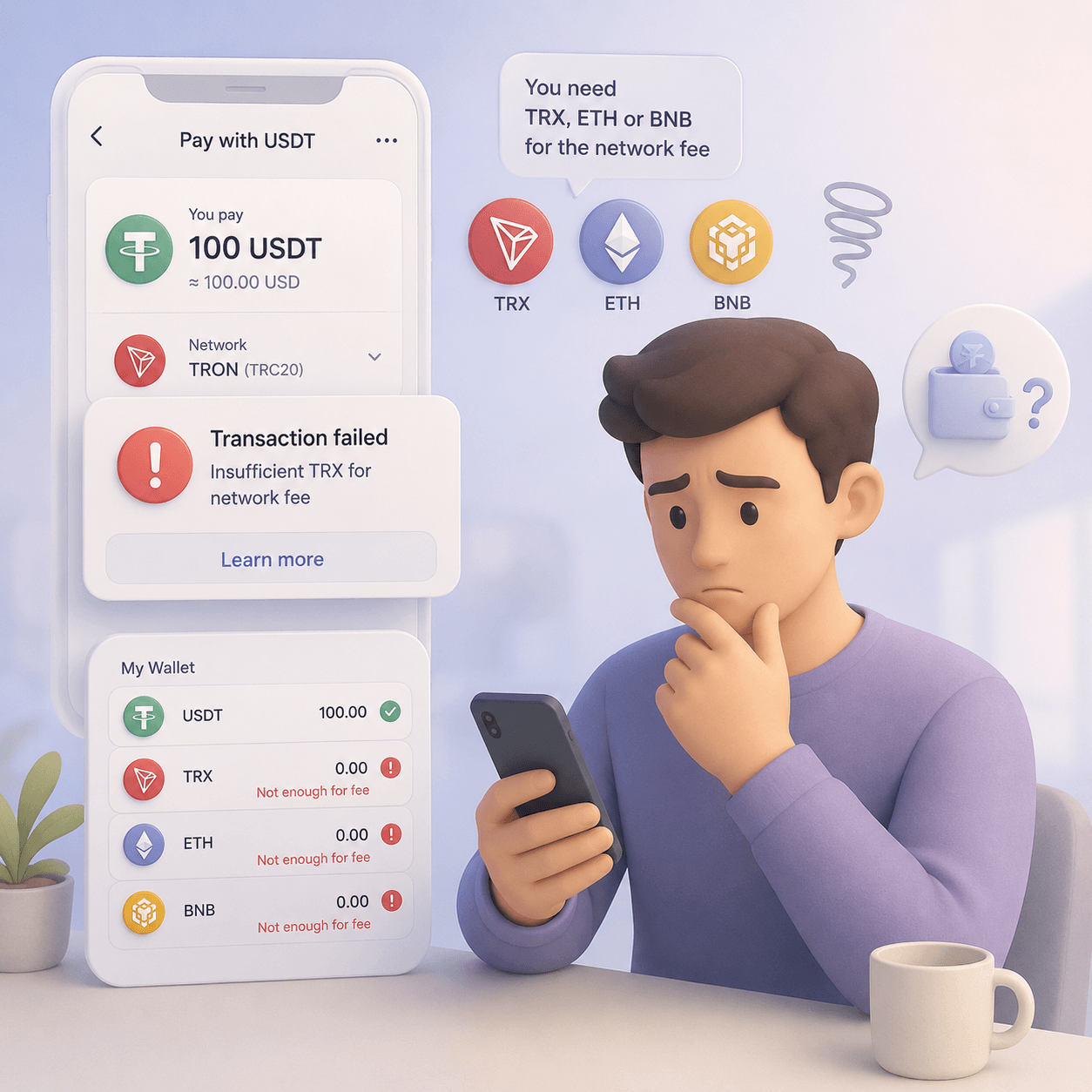
Gas is a common source of errors. A customer may hold USDT but have no TRX, ETH, BNB, MATIC, or other native token needed for the network fee. This is why gasless USDT payments and network-fee-aware flows can reduce payment failures and support tickets.
Security should not mean adding friction everywhere. It should mean guiding the customer through the safest path.
The risk does not end when the customer pays.
Finance teams need to know which order the payment belongs to, which asset was received, which network was used, what fees were applied, when funds became available, whether the amount was converted, and where funds were withdrawn.
For CFOs, stablecoin payment operations are often more important than the checkout itself. Stablecoins such as USDT can reduce volatility exposure, but they still require clear settlement rules, reconciliation, reporting, and withdrawal controls.
A secure post-payment process should cover:
Withdrawal controls deserve special attention. A business may accept payments safely but lose funds through weak admin access, compromised credentials, or poorly controlled payout rules. Use 2FA, strong access policies, separation of duties, and internal approval rules for large or unusual withdrawals.
Stablecoins are central to many crypto payment flows because they reduce volatility and make pricing easier. For online businesses, USDT and other stablecoins often fit better than volatile assets for invoices, balances, subscriptions, and settlement.
But stablecoins also attract regulatory attention. In Europe, stablecoin payments after MiCA require businesses to think more carefully about provider status, supported assets, AML processes, customer geography, and settlement operations.
This does not mean every merchant has the same obligations as a crypto exchange or stablecoin issuer. Requirements depend on jurisdiction, business model, transaction flow, custody model, and the role of your provider. A merchant accepting payments through a provider has a different profile from a company issuing tokens or operating a custodial wallet.
Still, businesses should avoid three assumptions:
A safer approach is to define your own policy first: which customers you serve, which countries you avoid, which assets and networks you accept, which transaction types you review, and which provider controls you rely on.
Some business models need stronger crypto payment controls because the payment flow is more complex.
For crypto payments for marketplaces, risk is not limited to the buyer. The platform also has sellers, commissions, order disputes, refunds, seller balances, and payouts. A marketplace may need to delay withdrawals until payment status is final and risk checks are complete.
For iGaming payment processing, deposits and balances create additional operational risk. Fast top-ups are important for conversion, but the platform also needs payment limits, KYC/AML alignment, suspicious activity rules, and clear treatment of flagged deposits.
For PSPs, ad networks, affiliate platforms, hosting, VPN, digital products, and SaaS, the main issue is usually automation. Payments may need to credit an account balance, unlock access, renew a subscription, or trigger a payout. The more automated the product is, the more important it becomes to design safe status handling and audit logs.
High volume does not only increase revenue. It increases the cost of small mistakes.
Before going live, evaluate a provider across risk, integration, operations, and customer experience.
A secure crypto payment provider should help you answer these questions:
Do not choose a provider only because it supports many coins. For most businesses, the stronger provider is the one that reduces operational risk: fewer wrong payments, clearer statuses, better reporting, safer withdrawals, and better handling of AML reviews.
CryptumPay is built for businesses that need to accept crypto payments on a website, app, Telegram bot, or other digital platform without turning every payment into a manual transfer.
In a secure payment model, the useful parts are not just “accept USDT” or “show a QR code.” The important parts are the controls around the payment: AML checks, 2FA, a merchant dashboard, API and HTML widget options, automatic conversion to USDT, withdrawal management, payment history, and support for popular assets and networks.
For customer experience, CryptumPay can support QR/app-based payment scenarios and repeat payment flows. For operations, it helps reduce errors around network fees and manual transfers. For finance, USDT conversion and dashboard records make payment control easier than tracking disconnected wallet transactions.
This does not replace legal advice, internal policy, or jurisdiction-specific compliance work. But it gives businesses a stronger infrastructure layer than asking customers to send funds to a static wallet address.
Before launch, make sure your team can answer these questions:
Secure crypto payments are not created by one AML checkbox. They come from a payment flow where risk controls, integration logic, customer experience, settlement, and internal operations work together.
Create an account and connect the checkout yourself, or talk to sales and we will plan the integration with you.