
23.05.2026
x402 Payments for AI and API Products: Stablecoin Micropayments Guide
Read article

iGaming payment processing is no longer just a deposit button on a casino or sportsbook website. For an operator, it is one of the most sensitive parts of the business: it affects first deposits, repeat deposits, withdrawals, player trust, support workload, compliance checks, and finance operations.
A weak payment setup usually looks acceptable during launch. Players can open the cashier, choose a method, and try to deposit. The problems appear later: card declines in one region, wallet limits in another, delayed bank transfers for VIP players, unclear crypto statuses, players sending USDT on the wrong network, support asking finance for transaction screenshots, and compliance teams reviewing risky deposits manually.
That is why iGaming payment processing in 2026 should be treated as a payment stack, not as one gateway. The operator needs a cashier experience for players, payment providers underneath, local methods for target markets, crypto and stablecoin rails where relevant, clean balance-crediting logic, AML controls, reporting, and a support workflow that can handle imperfect payments.
If you are still choosing the broader platform, start with the foundation first: your iGaming platform software must be able to support the payment logic you want to build. A strong payment provider cannot fully compensate for a platform that has weak wallet logic, poor API access, or limited back-office visibility.
An iGaming payment stack has several layers. Some are visible to players. Others are invisible but critical for operations.
At minimum, the stack should include:
This is why “more payment methods” is not a strategy by itself. A casino can offer many logos in the cashier and still lose deposits if the methods are poorly ordered, unavailable in key regions, unclear on mobile, or disconnected from the back office. A better approach is to design the stack around real player behaviour and operational control.
A useful starting point is the same principle covered in the guide to multiple payment methods: options matter, but only when they reduce friction for the right customer segment.
Many operators start by asking, “Which payment gateway should we connect?” A better question is, “Which payment methods do our target players actually use, and what happens after they try to deposit?”
Payment preferences differ by region, player profile and product type. A sportsbook with mobile-first traffic in one market may need local instant payments and wallets. A crypto-friendly casino may need USDT, BTC and fast balance top-ups. A VIP-heavy brand may need bank transfers or higher deposit limits. An operator entering several regions may need multiple PSPs and routing logic rather than a single provider.
Before choosing a gateway, define:
This prevents a common mistake: connecting a payment method because it is popular globally, while the target player base does not use it or cannot access it reliably.
A strong iGaming payment setup usually combines several method categories. Each one has benefits and trade-offs.
Cards remain familiar in many markets. They are easy for mainstream players and work well when approval rates are stable, fraud controls are mature, and the operator has suitable acquiring coverage.
The limitations are also clear. iGaming is often treated as a high-risk category. Approval rates can vary by region and issuer. Chargebacks may create cost and risk. Some banks restrict gambling-related payments. For mobile users, card entry can also add friction if the cashier does not support saved cards, tokenization or wallet-based flows.
Cards can be useful, but they should not be the only deposit path for an international iGaming business.
E-wallets can reduce friction for players who do not want to enter card details directly on a gambling platform. They may also support faster withdrawals in some regions.
The trade-off is coverage. A wallet that works well in one market may be irrelevant in another. Fees, account limits, verification rules and withdrawal capabilities can differ significantly. For an operator, the key question is not whether a wallet is popular in general. It is whether it is popular among the players you are trying to acquire.
Local methods can be decisive for conversion. In many markets, players expect familiar domestic systems: instant bank payments, local wallets, account-to-account transfers, cash-based vouchers, mobile money or national payment rails.
Local methods are useful because they match player habits. They can also help operators enter markets where international cards perform poorly. But they add operational complexity. Each method may have its own limits, settlement timing, refund rules, reconciliation format, provider relationship and compliance requirements.
Bank transfers can work for larger deposits, VIP segments and some regulated markets. They may be trusted by players and finance teams, especially when the operator needs clear banking records.
The downside is speed and user experience. Manual bank details, delayed settlement, weekend delays and unclear payment references can create friction. For live betting or fast casino sessions, a delayed deposit can mean the player leaves before the money arrives.
Vouchers can be useful for certain regions and player segments, especially where cash-based funding remains common. They may reduce card exposure and help players who prefer not to connect a bank account.
However, voucher flows can be limited by purchase availability, amount caps, fees and lack of payout support. They are rarely enough for a full payment strategy.
Crypto payments are especially relevant for international, digital-first and crypto-friendly audiences. They can support players who already hold BTC, ETH, TRX, BNB, SOL, XRP, USDT or other assets, and they can be useful when traditional rails are expensive, slow or unreliable.
Stablecoins such as USDT are often more practical for iGaming than volatile assets because they give operators and players a more predictable unit of account. But crypto is not automatically simple. The payment flow must handle network choice, gas fees, confirmations, expired invoices, underpayments, AML screening, transaction visibility and settlement.
For a deeper industry-specific overview, see the guide on crypto payments for online casinos and sports betting platforms.
In e-commerce, payment often ends with order confirmation. In iGaming, payment is part of an ongoing player balance. That changes the design.
A deposit flow should answer several questions:
This is where iGaming differs from a simple “pay now” scenario. The operator needs a reliable connection between payment, player ID, internal balance, bonus rules, risk checks, finance records and support visibility.
If first-time deposits are a priority, payment UX should be reviewed together with product and growth teams. The guide on why players and bettors refuse to deposit covers this conversion problem in more detail.
The first deposit proves that the player can pay. Repeat deposits prove that the payment experience is good enough to support retention.
A returning player should not have to repeat unnecessary steps every time. If the method, risk profile and jurisdiction allow it, the product should make the second and third deposit easier than the first one. This can involve saved payment preferences, remembered networks, clearer default amounts, recent methods, faster confirmation, and fewer manual instructions.
Crypto deposits make this especially important. A player who already paid with USDT on TRON should not be forced to think through the whole flow again each time. The cashier should guide the player toward the correct token, network and amount, while the backend still performs the necessary checks.
The broader principle is simple: easy deposits should not mean weak controls. It means the system remembers safe context, explains the next step clearly, and avoids avoidable mistakes. This is the same issue covered in the article on why easy payments matter in online casinos.
Crypto should not be positioned as a universal replacement for all payment methods. In most serious payment stacks, it is an additional layer for specific use cases:
The operator should decide where crypto belongs in the cashier. It may be a primary method for a crypto-native casino, an alternative method for international users, or a secondary method for players who fail with cards. The position matters because cashier ordering affects user behaviour.
A good crypto deposit flow should feel like a payment, not like a manual blockchain operation. The player should not need to copy long wallet addresses, guess the correct network, calculate gas, or wonder whether the transaction was detected. The system should show the asset, network, amount, expiration time and status clearly.
Failed crypto payments are not only a technical issue. They affect conversion, player trust and support load.
Common reasons include:
These issues are predictable, so the payment flow should be designed around them. The cashier should explain network selection before payment. The invoice should show the exact amount. The backend should have statuses for underpayment, late payment and pending confirmation. The player should see what is happening instead of opening a support ticket after every delay.
The practical playbook is covered in more depth in how to reduce failed crypto payments.
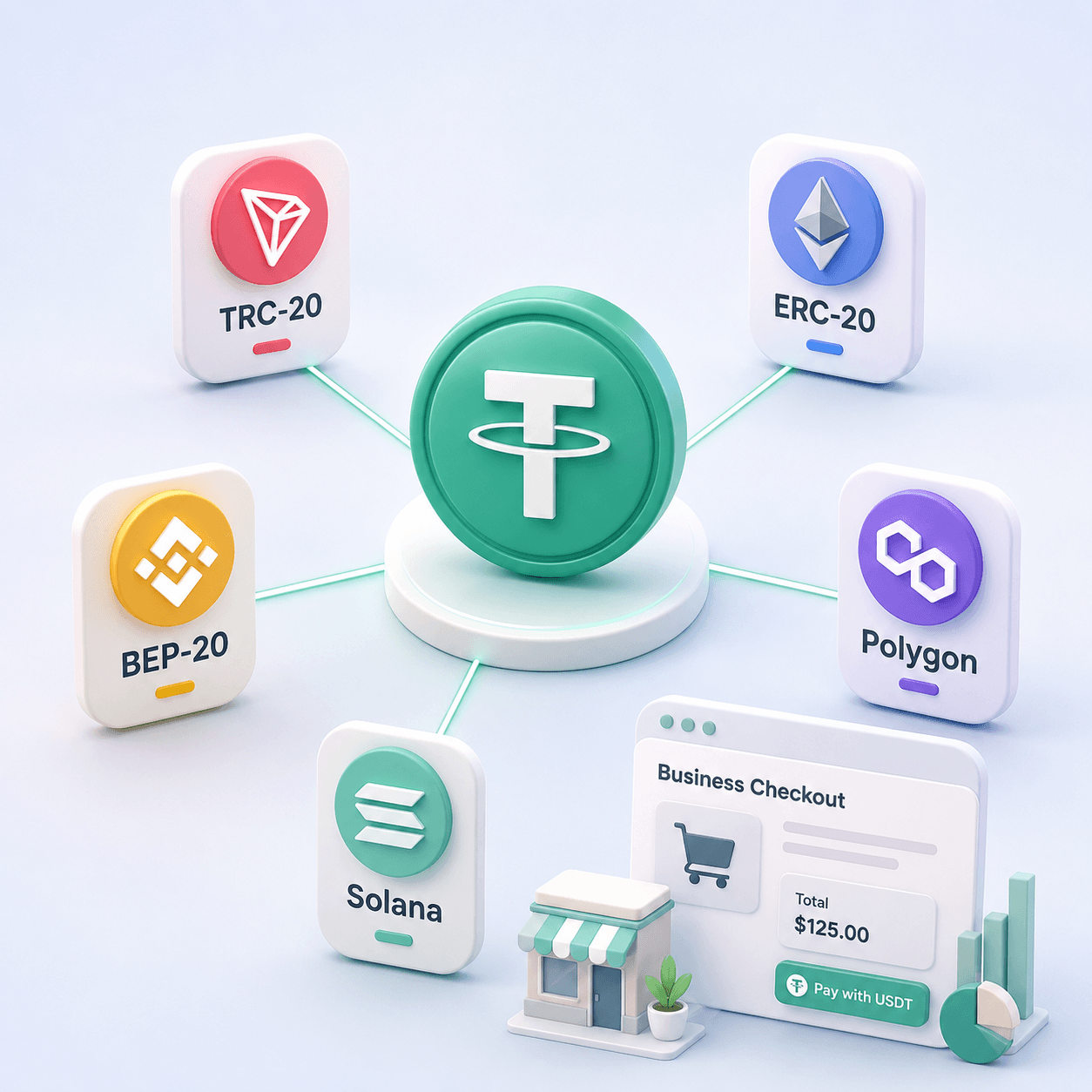
USDT is widely used, but USDT is not one payment rail. It can move on TRON, Ethereum, BSC, Polygon, Solana and other networks. Each network has its own fees, confirmation behaviour and native token requirements.
For example, a player paying USDT on TRON may need TRX to cover network fees. On Ethereum, they may need ETH. On BSC, they may need BNB. If the player does not have the required native token, the deposit may fail before it starts.
For iGaming, this is a serious friction point. The player may be ready to deposit, but the wallet cannot send the transaction. The operator then loses a payment or receives a support request that starts with: “I have USDT, why can’t I pay?”
This is why gas handling should be part of provider evaluation, not an afterthought. The cashier should make network requirements clear, and the provider should help reduce avoidable gas-related failures where possible. The issue is explained in detail in Gasless USDT Payments.
Operators that accept USDT should also understand token standards. The differences between TRC-20, ERC-20, BEP-20 and other formats affect fees, UX, support and reconciliation. For a deeper comparison, see the guide to USDT token standards.
A payment stack that works for players may still fail finance operations.
Finance teams need to know:
Stablecoin settlement can make operations more predictable, especially when the operator does not want exposure to BTC, ETH or other volatile assets. But the finance team still needs clear records: player ID, transaction hash, network, amount, status, fee, conversion rate if applicable, and withdrawal history.
This is why payment reporting should be evaluated before launch. If the team relies on screenshots, wallet addresses and manual spreadsheets, the setup will not scale. The operational side of this topic is covered in stablecoin payment operations for CFOs.
For CTOs and product teams, the most important question is not only “Does the provider have an API?” It is whether the API supports real iGaming workflows.
A production-ready payment integration should cover:
For simpler products, an HTML widget or hosted payment form may be enough. For an iGaming platform that credits balances automatically, API quality is usually more important. The detailed technical criteria are covered in the crypto payment API checklist.
The key rule: never treat a frontend redirect as proof of payment. The backend should confirm the payment status server-side before it credits a player balance.
iGaming payments sit at the intersection of gambling regulation, payment regulation and, in crypto scenarios, digital asset rules. Requirements depend on jurisdiction, licence model, player location, payment method, transaction size, provider role and internal risk policies.
This article is not legal advice, but operators should plan for risk controls from the beginning.
A payment stack should support:
Crypto does not remove the need for controls. It changes what the controls need to see. Instead of only card issuer, wallet provider or bank reference, the team may need transaction hashes, wallet risk signals, network data, payment source patterns and withdrawal behaviour.
For more context, see the guide to secure crypto payments, AML and KYC.
A provider comparison should not be based only on fees or logo coverage. The right gateway depends on the operator’s market, product model and operating team.
Use these questions before connecting a payment gateway:
For international operators, the best setup may be multi-provider rather than single-provider. One provider may be strong in cards, another in local payments, another in crypto, and another in payouts. The challenge is making them work together without confusing players or fragmenting internal data.
CryptumPay is relevant when an iGaming operator wants to add crypto and stablecoin payments without turning deposits into manual wallet transfers.
It can fit as the crypto layer inside a broader payment stack: cards, wallets and local methods can still serve traditional players, while CryptumPay handles crypto-friendly users who want to deposit with assets such as BTC, ETH, TRX, BNB, SOL, XRP, MATIC or USDT.
For iGaming scenarios, the useful parts are practical:
This does not mean crypto should replace every payment method. It means operators serving crypto-friendly players can add a dedicated crypto payment layer while keeping the broader cashier strategy intact.
The most expensive payment mistakes usually happen before launch.
Avoid these:
A good iGaming payment stack is not the one with the longest list of methods. It is the one that helps the right player deposit smoothly, gives the operator control, and reduces manual work when something goes wrong.
iGaming payment processing is the system that lets online casinos, sportsbooks and betting platforms accept deposits, process withdrawals, credit player balances, manage payment statuses, reconcile funds, and apply risk controls. It usually includes a cashier, payment providers, player wallet logic, reporting, AML/KYC workflows and backend integration.
The right mix depends on target markets and player segments. Many operators combine cards, e-wallets, local payment methods, bank transfers, vouchers, crypto and stablecoins. The goal is not to add every possible method, but to support the methods that improve deposits, withdrawals, trust and operational control in each market.
Crypto payments can be useful when the audience is international, crypto-friendly or underserved by traditional rails. Stablecoins such as USDT can also help with more predictable value. However, operators still need clear network selection, gas handling, AML checks, payment statuses, reporting and support workflows.
Operators can reduce failed deposits by improving cashier UX, offering relevant local methods, showing clear payment instructions, handling pending and expired payments properly, using server-side payment confirmation, explaining crypto networks and gas, and giving support teams direct access to transaction status.
A single gateway can work for a small launch or one market. Multi-market operators often need several providers because payment preferences, approval rates, local methods, crypto demand and compliance requirements vary by region. The important part is to keep the player experience coherent and internal reporting unified.
iGaming payment processing in 2026 is a strategic layer of the business. It affects conversion, retention, withdrawals, finance operations, compliance and support workload.
The strongest operators do not choose payment methods randomly. They build a stack around target markets, player behaviour, deposit speed, payment reliability, crypto readiness, stablecoin settlement, API quality, AML controls and back-office visibility.
Cards, wallets, local methods and bank transfers still matter. Crypto and stablecoins add another useful layer for international and crypto-friendly players. But every method should be connected to a clear operating model: how the player pays, how the platform credits the balance, how finance reconciles funds, how support handles errors, and how compliance reviews risk.
That is the difference between simply accepting payments and building payment processing that can support a real iGaming business.
Create an account and connect the checkout yourself, or talk to sales and we will plan the integration with you.